The Paper Orchestra
Yavuz DEMİRKIRAN
- Category Children's Fairy Tales
- Format PDF
- Size 12.2 MB
- Added 29.10.2026
- Views 2
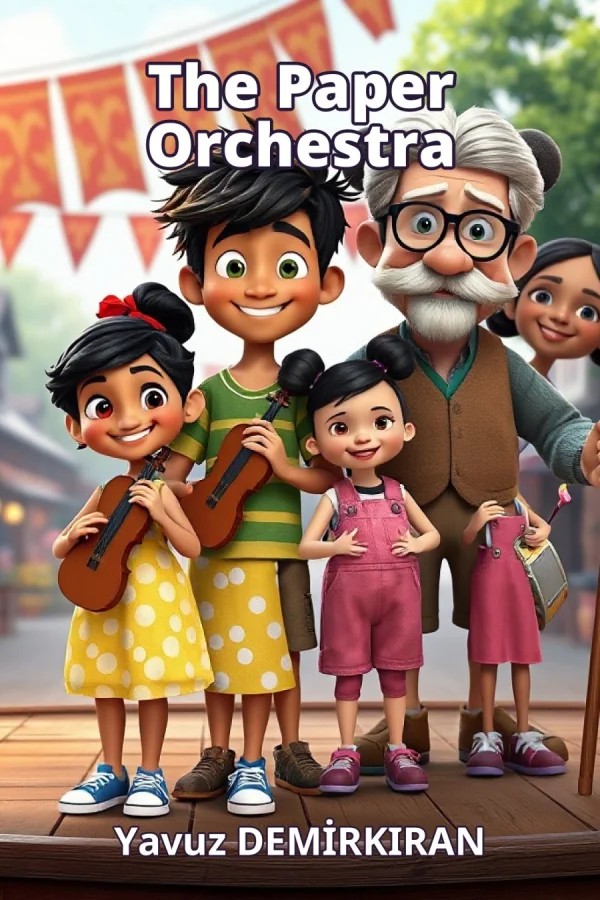
In a cozy village nestled between green hills, everyone is busy preparing for the big festival. But Mira, a small girl with a red ribbon in her curly black hair, has a problem: she promised the village that she and her friends would play music at the festival, yet the barn holds no instruments at all. Rather than give up, Mira pulls a sheet of paper from her pocket and starts folding. Her idea is simple and bold: if there are no instruments, the children will make their own.
Tom, a tall boy with a gap-toothed grin, struggles at first, his paper flute looking more like a crumpled duck, while shy little Anna quietly folds a perfect round paper drum. The three friends bring their creations to Grandpa Joseph, the village elder, who teaches them that music lives in the player, not the instrument. Over two days of practice, the paper orchestra slowly comes together, even as some villagers shake their heads and doubt that paper can make real music.
On festival day, the children step onto the small wooden stage with nervous hands and beating hearts. The story follows their courage, their teamwork and the moment their folded violins, flutes and drums fill the square with sound. It is a gentle tale for young readers about creativity, perseverance and believing in yourself, and about how encouragement from friends and elders can help ordinary paper become something wonderful.
Read the Book
If the PDF does not appear, open it in a new tab.
A Chapter from the Book
The Paper Orchestra Yavuz DEMİRKIRAN
In a cozy village nestled between green hills, everyone was busy getting ready for the big festival. Banners fluttered, pies cooled on windowsills, and children ran through the streets. But Mira, a small girl with warm brown skin and a red ribbon in her curly black hair, sat on a bench with a frown. The festival was only three days away, and she had a big problem. 1
Mira had promised the village that she and her friends would play music at the festival. But when they looked in the barn, they found no instruments at all. "No violins, no flutes, no drums," said Tom, a tall boy with messy sandy-blond hair and a gap-toothed grin. "What are we going to do?" Mira tapped her chin. She was resourceful, and she was not ready to give up. 2
Mira pulled a sheet of paper from her pocket and started folding it. "What if we make our own instruments?" she said. Tom laughed. "Paper? That won't make music!" But Mira kept folding, her dark brown eyes sparkling with an idea. She folded and creased until a little paper violin appeared in her hands. "We can try," she said. "We just need to be creative." 3
Tom, who loved a challenge, grabbed a sheet and tried to fold a flute. His first try looked more like a crumpled duck. His second try was a lopsided tube. "This is hard!" he groaned, pushing his messy hair out of his eyes. But Mira encouraged him. "Keep trying," she said. "We'll figure it out together." Tom took a deep breath and folded again, more carefully this time. 4
Anna, a shy girl with two puffy buns, watched quietly. She was the youngest, and she had a small bandage on one finger from a paper cut. "Can I help?" she whispered. Mira smiled and showed her how to fold a round paper drum. Anna's round cheeks dimpled as she worked, and her paper drum came out perfectly. "It's beautiful," Anna said softly. "Now we just need to make them play." 5
The three friends took their paper instruments to Grandpa Joseph, the village elder. He sat on his porch, leaning on a wooden walking stick, his white moustache twitching with interest. "Music lives in the player, not the instrument," he said gently. "Let me show you." He taught them to tap a steady beat and to blow softly across the paper flute's edge. "Rhythm is the heart of music," he told them. 6
For two days, the children practiced. Tom's paper flute finally whistled, and he played a simple melody that made everyone smile. Anna tapped her paper drum with steady hands, keeping the beat for the whole group. Mira's paper violin sang with a soft, sweet sound. "We're really doing it!" Mira cheered. "Our paper orchestra is coming together." The children practiced until the sun set behind the hills. 7
But not everyone believed in them. Some villagers shook their heads. "Paper instruments? They won't make real music," said the baker. Tom's shoulders slumped. "Maybe they're right," he mumbled. Anna looked down at her paper drum, her dimples gone. But Mira stood tall. "We've worked too hard to quit now," she said firmly. "Let's show them what we can do." 8
On festival day, the village square was bustling with people. There were games, treats, and decorations everywhere. But when it was time for the children's performance, the crowd grew quiet. Some people whispered and pointed at the folded paper instruments. The children felt nervous. Tom's hands shook, and Anna's heart beat fast. But Mira took a deep breath and smiled at her friends. "Together," she said. 9
The children stepped onto the small wooden stage. Mira raised her paper violin, Tom lifted his paper flute, and Anna held her paper drum tight. The crowd watched curiously. For a moment, there was silence. Then Tom took a deep breath and played the first note on his paper flute. It was clear and sweet, like a bird's song. The magic had begun. 10
Anna tapped her paper drum, and a soft, steady beat rolled through the square. Mira drew her paper bow across the paper violin, and a warm melody floated into the air. The three sounds joined together perfectly. The paper orchestra was making real music! The villagers gasped. The baker's mouth fell open. The children played on, their hearts full of joy. 11
Something wonderful happened next. The music seemed to dance around the square, and people began to tap their feet. First one, then another, then everyone was clapping and dancing. The baker grabbed a spoon and played along on a pot. Grandpa Joseph smiled from ear to ear. "I told you," he said. "Music lives in the player." 12
The children played song after song, and the whole village danced and laughed. When they finished, the crowd burst into cheers and applause. The baker apologized for doubting them. "Your paper orchestra is the best thing at the festival!" he said. Mira, Tom, and Anna beamed with pride. They had turned simple paper into real music, and the village had loved it. 13
After the performance, Grandpa Joseph gathered the children around him. "You see," he said, his warm brown eyes crinkling, "with imagination and resourcefulness, you can create something beautiful from almost nothing." The children nodded, understanding. They had learned that creativity could turn simple things into real music. And they had proven it to the whole village.
This section is a preview taken from the book (about 921 words). To continue, read the book or download the PDF.
Book Details
- Book
- The Paper Orchestra
- Author
- Yavuz DEMİRKIRAN
- Category
- Children's Fairy Tales
- Language
- English
- Format
- PDF · 12.2 MB
- Pages
- 18
- Words
- about 1,048
- Published
- Online Masal · 29.10.2026
- Access
- Free to read and download; for personal use only, all rights belong to the author.
Frequently Asked Questions
Is the PDF of The Paper Orchestra free?
Yes. The Paper Orchestra can be read and downloaded for free on this site; no sign-up or payment is required.
How many pages is The Paper Orchestra?
The Paper Orchestra has 18 pages and about 1,048 words.
Which devices can I read The Paper Orchestra on?
It is a PDF; you can read it in your browser on a phone, tablet or computer, or download it and open it offline.
Who is the author of The Paper Orchestra?
The Paper Orchestra was written by Yavuz DEMİRKIRAN; it is listed in the Children's Fairy Tales category.