The Science Garden
Yavuz DEMİRKIRAN
- Category Children's Fairy Tales
- Format PDF
- Size 13.3 MB
- Added 29.10.2026
- Views 2
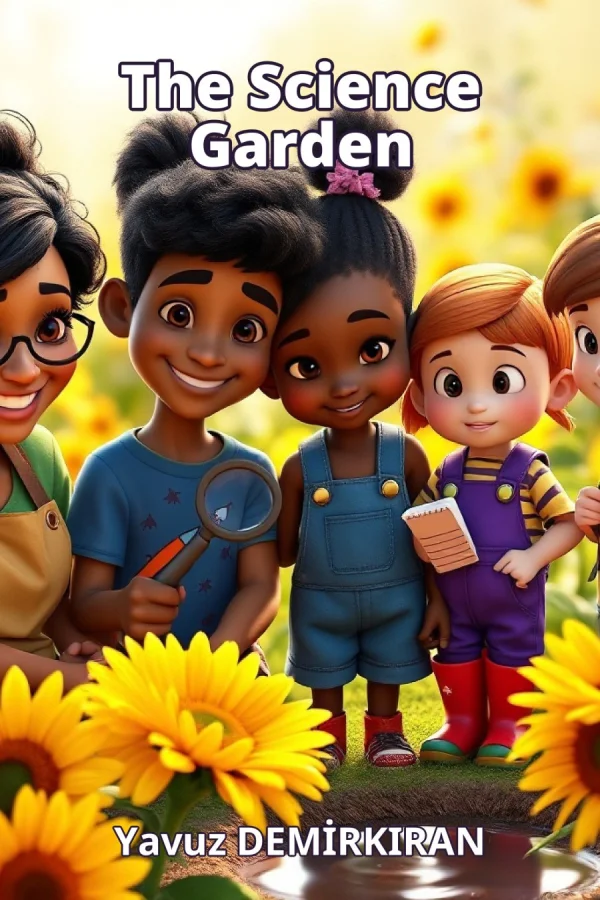
Ms. Rosa's class skips down the path to the science garden, an outdoor laboratory full of bright flowers and buzzing bees. Leo carries a magnifying glass, Maya holds her notebook ready, and Sam splashes through every puddle in his red boots. Ms. Rosa, wearing her green apron, invites the children to discover how plants respond to the world around them.
In the garden the class meets moonflowers that stay closed in daylight, sunflowers that turn their heads to follow the light, and bell-shaped flowers that sway faster when Sam taps his water bottle like a drum. Leo tries a flashlight on the moonflowers with no luck, and Maya writes down every result. Sam waters a droopy plant and watches it perk up within seconds, while the children learn the word phototropism and see that science takes patience. When one flower begins to quiver for the first time, the class realizes the garden still holds surprises.
The story follows the children as they test light, sound and water, record their findings and build a chart on the garden fence. Ms. Rosa gives each child a seed to plant at home and keep experimenting. Young readers learn that plants cannot run away, so they use light, sound and water to survive, and that careful observation and patience are the heart of science. The book suits early elementary readers and anyone sharing a first lesson about how living things respond to their environment.
Read the Book
If the PDF does not appear, open it in a new tab.
A Chapter from the Book
The Science Garden Yavuz DEMİRKIRAN
Ms. Rosa's class skipped down the path to the science garden, a place full of bright flowers and buzzing bees. Leo's magnifying glass bounced on its string as he ran ahead. Maya held her notebook tight, ready to write. Sam's red boots splashed in every puddle. "Welcome to our outdoor laboratory!" Ms. Rosa said, her green apron flapping in the breeze. 1
The garden had rows of flowers in every color. Some were tall, some were tiny, and some had leaves that curled like ribbons. "These plants are special," Ms. Rosa explained. "They show us how science works." Leo leaned close to a big yellow flower. "Do they do tricks?" he asked. Maya opened her notebook. "Let's find out!" she said. 2
Ms. Rosa pointed to a patch of white flowers closed up tight. "These are moonflowers," she said. "They open when it's dark." Sam scratched his freckly nose. "So they like night better than day?" he asked. "Exactly," Ms. Rosa said. "Light tells them when to bloom." Leo grinned. "Then let's test them with light!" he shouted. 3
Leo grabbed a flashlight from the garden shed. He shone it on the moonflowers, but they stayed shut. "Maybe they need real sunlight," Maya suggested, writing in her notebook. Sam pulled a small lamp from his backpack. "How about this?" he asked. The flowers still didn't move. Ms. Rosa smiled. "Science takes patience," she said. "Keep trying!" 4
Next, the class visited a patch of sunflowers. These flowers turned their heads toward the sun. Leo ran around them, and their heads swiveled to follow him. "They're watching me!" he laughed. Maya drew a picture in her notebook. "They follow the light," she said. "That's called phototropism." Sam waved his arms. "Hello, flowers!" he called. The sunflowers seemed to wave back. 5
Then they heard a soft humming sound. Ms. Rosa led them to a group of bell-shaped flowers that swayed gently. "These are dancing flowers," she said. "They move when they hear music." Sam pulled out his water bottle and tapped it like a drum. The flowers swayed faster. Leo clapped his hands, and they swayed even more. "They love rhythm!" Maya said, writing quickly. 6
Sam wanted to try his own experiment. He took out his small watering can and sprinkled water on a droopy plant. Within seconds, the plant perked up and its leaves turned bright green. "Wow!" Sam said. "It's like a drink of energy!" Leo ran over with his magnifying glass. "Let me see!" he said. The plant's leaves were covered in tiny hairs that sparkled with water. 7
Ms. Rosa explained that some flowers open in bright light, others sway to sound, and some perk up with water. "Each plant responds to its environment," she said. "That's how they survive." Leo raised his hand. "Can we test more?" he asked. Maya nodded. "I'll record everything," she said. Sam filled his watering can again. "I'm ready!" he cheered. 8
The class split into teams. Leo tested which flowers opened fastest in sunlight. He placed a cardboard box over one flower and watched it close. Maya compared the results in her notebook. "This one closes in shade," she said. "And this one opens in light." Sam watered a wilted plant and timed how long it took to stand up. "Ten seconds!" he announced. 9
Then something surprising happened. A flower that had never moved before started to quiver. "Look!" Maya whispered. The flower's petals opened and closed like a fan. Leo shone his flashlight on it. "It's reacting to light!" he said. Sam clapped, and the flower quivered faster. Ms. Rosa smiled. "You've discovered a new response," she said. "Science is full of surprises." 10
The children gathered around Ms. Rosa. "Why do plants do these things?" Leo asked. She knelt beside a flower. "Plants can't run away, so they use light, sound, and water to stay healthy," she explained. "They grow toward light, drink water, and even respond to vibrations." Maya wrote it all down. "So they're like tiny scientists!" Sam said. 11
Leo had an idea. "Let's make a chart of everything we found!" he said. Maya drew three columns: light, sound, and water. Together they listed which flowers responded to each. Sam added a smiley face next to the water column. "Water makes everyone happy," he said. Ms. Rosa hung the chart on the garden fence. "Your discoveries will help others learn," she said. 12
Ms. Rosa gave each child a small pot and a seed. "Plant these at home and keep experimenting," she said. "Watch how they respond to light and water." Leo held his seed like a treasure. "I'll test mine with music!" he said. Maya carefully labeled her pot. Sam filled his watering can one last time. "This is the best science class ever!" he announced. 13
Back in the classroom, the children talked about their favorite discoveries. Leo loved the dancing flowers. Maya was proud of her careful notes. Sam couldn't stop talking about the plant that perked up with water. Ms. Rosa listened with a warm smile. "You asked questions, tested ideas, and learned from nature," she said. "That's what real scientists do." 14
The next week, the class returned to the science garden. The sunflowers were taller, the moonflowers had bloomed, and the dancing flowers swayed in the breeze. "Our experiments helped the garden grow," Maya said. Leo nodded. "And the garden helped us learn," he added. Sam watered a thirsty plant. "Science is everywhere!" he cheered.
This section is a preview taken from the book (about 923 words). To continue, read the book or download the PDF.
Book Details
- Book
- The Science Garden
- Author
- Yavuz DEMİRKIRAN
- Category
- Children's Fairy Tales
- Language
- English
- Format
- PDF · 13.3 MB
- Pages
- 18
- Words
- about 988
- Published
- Online Masal · 29.10.2026
- Access
- Free to read and download; for personal use only, all rights belong to the author.
Frequently Asked Questions
Is the PDF of The Science Garden free?
Yes. The Science Garden can be read and downloaded for free on this site; no sign-up or payment is required.
How many pages is The Science Garden?
The Science Garden has 18 pages and about 988 words.
Which devices can I read The Science Garden on?
It is a PDF; you can read it in your browser on a phone, tablet or computer, or download it and open it offline.
Who is the author of The Science Garden?
The Science Garden was written by Yavuz DEMİRKIRAN; it is listed in the Children's Fairy Tales category.