The Silver Puppet Strings
Yavuz DEMİRKIRAN
- Category Children's Fairy Tales
- Format PDF
- Size 11.3 MB
- Added 29.10.2026
- Views 2
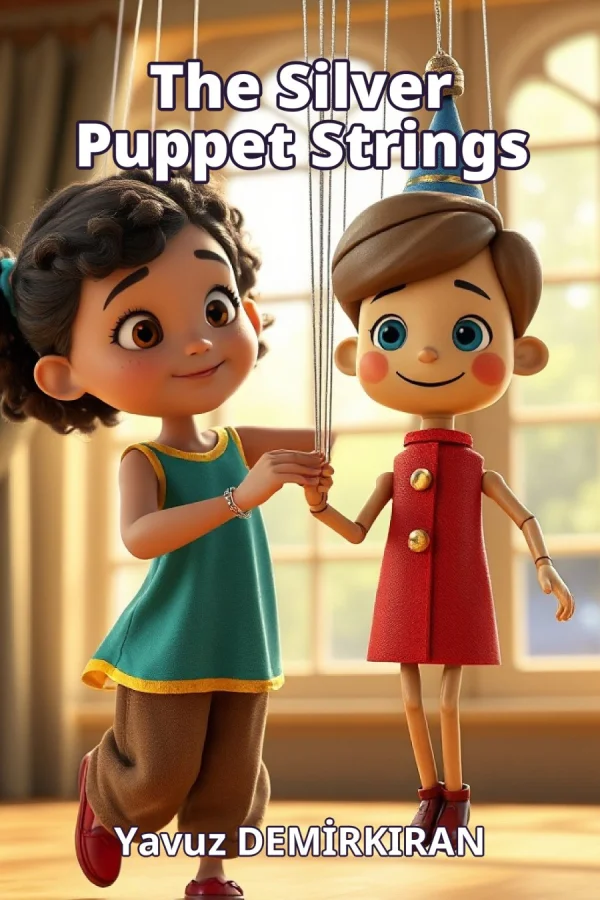
In a sunny room, Lily practices with her wooden puppet Pip, who wears a blue pointed hat and a tiny bell. Using silver strings attached to his head, hands, and knees, she tries to teach him to dance. At first, Pip wobbles and tumbles, but Lily learns to listen to the music and move her hands more gently.
As she practices, Lily discovers that breaking the dance into small parts and matching her movements to different rhythms helps Pip improve. She practices bowing, stepping, and spinning, and gradually their coordination grows. When her neighbor asks to see Pip dance, Lily performs a gentle waltz, and Pip dances beautifully, showing how far they have come.
This heartwarming story teaches children the value of patience, practice, and listening. It shows that with perseverance and attention to rhythm, even difficult tasks can be mastered. The book is perfect for young readers who enjoy stories about determination and the joy of learning.
Read the Book
If the PDF does not appear, open it in a new tab.
A Chapter from the Book
The Silver Puppet Strings Yavuz DEMİRKIRAN
In a little room with a big sunny window, Lily sat on a stool with silver threads wrapped around her fingers. Her puppet Pip stood beside her, no taller than her forearm, with a blue pointed hat and a tiny bell. Sunlight touched his honeycoloured wood. "Today we will learn to dance," Lily said, and Pip's painted cheeks seemed to glow. 1
Lily tied the silver strings to Pip's head, hands, and knees. Each string was thin and bright, like a thread of moonlight. Pip wore a red tunic with gold buttons, and his carved smile looked ready for something fun. Lily lifted her hands, and Pip dangled, his little wooden feet swinging above the floor, waiting for a song. 2
Lily placed a small music box on the table and turned the key. A light, tinkling waltz filled the room. She pulled the strings gently, and Pip lifted one wooden foot, then the other. But his arms flopped sideways and his head dipped low. "Oops," said Lily. Pip wobbled and tipped right over, his bell ringing softly. Music was not so easy after all. 3
Every afternoon, Lily tried again. She played the music box and tugged the silver strings, but Pip wobbled and tripped. His knees knocked together, and his pointed hat slipped over one big blue eye. "Maybe I'm pulling too fast," Lily said. She listened to the rhythm carefully and moved her hands more slowly, and Pip stood a little steadier. 4
One morning, Lily heard a different rhythm outside. The baker tapped a wooden spoon, tap-tap-tap, and a woman swept the steps, swish-swish. Lily lifted her hands to that easy beat. Pip swayed gently and stepped in time. "You're dancing a little!" Lily laughed. Her silver bracelet jingled, and Pip's bell jingled back, as if the puppet liked the sound. 5
Next, Lily tried a slow, hummed song. She moved the strings like pouring honey. Pip raised one arm, then the other, and made a small, careful bow. He only wibbled once, and Lily caught him with a quick tug. "Listening helps," she whispered. She practiced that bow again and again, until Pip's wooden arms curved smoothly and his bell stayed quiet. 6
But when the song got fast and jumpy, Pip went wild. His legs kicked, his arms spun, and the silver strings tangled around each other. Pip flopped onto the floor like a sleepy frog. Lily sighed. "That rhythm was too quick for my hands." She sat with Pip on her knee and untangled every silver thread, one by one. 7
"What if we practice one small piece at a time?" Lily said. She moved only Pip's head, tilting it left and right. Then only his hands, waving hello. Then only his knees, bending slowly. Pip watched her with his round blue eyes. Bit by bit, the silver strings grew used to her fingers, and her fingers grew used to the strings. 8
Each day after that, Lily practiced. She played a march and made Pip stomp, pom, pom. She played a lullaby and made him sway like a leaf. Sometimes he still wobbled. Sometimes his bell rang in the wrong place. But Lily only smiled and said, "Every try helps," and they tried once more, together. 9
One afternoon, Lily's neighbor came to listen. "Can your puppet really dance?" she asked. Lily took a deep breath and played a gentle waltz. Pip lifted his arms, stepped twice, and bowed. His silver strings shimmered in the sun. Lily's hands followed the music, and Pip followed her hands. He wobbled only a tiny bit, then spun around, and his bell rang happily. 10
Lily's neighbor clapped. "He dances beautifully!" Lily's warm brown cheeks flushed with pride. She had listened to so many rhythms and practiced so many days. Now her hands and the silver strings seemed to talk to each other. When the music rose, her fingers rose. When it slowed, her fingers slowed, and Pip moved like a little wooden dancer. 11
From that day, Lily invented new dances. A skipping song made Pip hop and wave his hat. A sleepy song made him bow goodnight. Sometimes Lily hummed while she worked, and Pip danced without any music box at all. Their coordination grew with every try, and Lily smiled at how far they had come, from wobbles and tumbles to spins and bows. 12
When the summer fair came to town, Lily brought Pip and her music box. "Come see the little dancer!" she called. The fair was busy and noisy, and at first Pip's strings shook. But Lily listened closely to the music, and her hands stayed steady. Pip spun in a circle, arms wide, and bowed low while his little bell chimed. 13
People gathered around and clapped, clap-clap-clap. Pip danced to a lively tune, then a slow one, then a funny one that made him wiggle. He never fell once. Lily's curly puffs bounced as she moved her hands, and her silver bracelet glittered. "He's wonderful!" someone said. Lily smiled, because she knew they had practiced a very long time. 14
That night, Lily sat by the window with Pip beside her. "You know," she said, "the silver strings move best when we follow the music." Pip's painted smile seemed to agree. Lily remembered the first day, when he wobbled and tripped right over. Now he could spin and bow with grace. Every wobble had taught them something.
This section is a preview taken from the book (about 915 words). To continue, read the book or download the PDF.
Book Details
- Book
- The Silver Puppet Strings
- Author
- Yavuz DEMİRKIRAN
- Category
- Children's Fairy Tales
- Language
- English
- Format
- PDF · 11.3 MB
- Pages
- 18
- Words
- about 979
- Published
- Online Masal · 29.10.2026
- Access
- Free to read and download; for personal use only, all rights belong to the author.
Frequently Asked Questions
Is the PDF of The Silver Puppet Strings free?
Yes. The Silver Puppet Strings can be read and downloaded for free on this site; no sign-up or payment is required.
How many pages is The Silver Puppet Strings?
The Silver Puppet Strings has 18 pages and about 979 words.
Which devices can I read The Silver Puppet Strings on?
It is a PDF; you can read it in your browser on a phone, tablet or computer, or download it and open it offline.
Who is the author of The Silver Puppet Strings?
The Silver Puppet Strings was written by Yavuz DEMİRKIRAN; it is listed in the Children's Fairy Tales category.