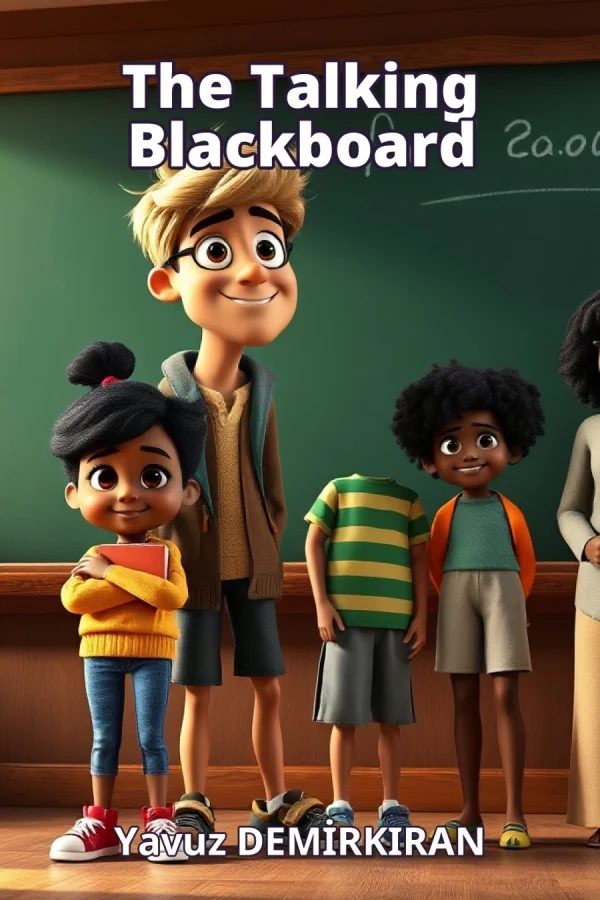
The Talking Blackboard
Yavuz DEMİRKIRAN
- Category Children's Fairy Tales
- Format PDF
- Size 11.1 MB
- Added 29.10.2026
- Views 3
In Ms. Lila Morrow's classroom, an old blackboard with a curling wooden frame and dark green slate begins to speak — not aloud, but by writing riddles in white chalk. When Maya, a small girl with a red clip in her springy curls, asks why the sky is blue, the board answers with a riddle instead of a fact. Alongside Theo, a tall, gap-toothed boy who keeps a pencil behind his ear, the class must puzzle out clues about letters, time, maps, pencil lead and clocks. Each new riddle pushes the children to slow down, share ideas and listen to one another rather than shout the first guess.
As the riddles grow trickier, Maya writes clues in her notebook and Theo's jokes keep the class smiling when answers are hard to find. Ms. Morrow steps back, sleeves rolled up, and lets her students investigate on their own. The children discover that questions are keys: a good question makes you think and listen, and teamwork makes solving problems faster and more fun. When the blackboard offers one last riddle about itself, the class realizes how much it has learned about curiosity and cooperation.
This gentle children's tale is suited to early primary readers and to adults reading aloud in class or at home. It shows how asking thoughtful questions, writing down clues and working together can turn a difficult problem into a shared adventure, and it ends with a small reward that invites children to write questions of their own.
Read the Book
If the PDF does not appear, open it in a new tab.
A Chapter from the Book
The Talking Blackboard Yavuz DEMİRKIRAN
In Ms. Lila Morrow's classroom, the blackboard was old and tall, with a curling wooden frame. Its dark green slate shimmered softly in the morning light. Ms. Morrow wrote the day's question in neat white chalk: 'What do you want to know?' Maya, a small girl with a red clip in her springy curls, raised her hand first. She always had questions. 1
Maya asked, 'Why is the sky blue?' The blackboard stayed still. Then, with a tiny sparkle of chalk dust, words appeared in white script: 'I have a riddle for you instead. I have no voice, but I speak to you. I have no legs, but I travel far. What am I?' The class gasped. Theo, tall and lanky with a gap-toothed grin, blurted, 'A ghost?' 2
Ms. Morrow smiled, her amber eyes twinkling behind her silver glasses. 'Let's think carefully,' she said. Maya opened her notebook and wrote the riddle down. Theo tapped his pencil, which was tucked behind his ear. The blackboard glowed gently, as if it were waiting. 'A letter!' Maya cried. The board wrote: 'Correct! You asked a question. Now ask a better one.' 3
The next day, Theo asked, 'What is the biggest number?' The blackboard sparkled. 'Riddle: I am always coming, but never arrive. I have a face and hands, but no arms. What am I?' Theo guessed, 'A clock?' The board wrote, 'Close, but think again.' Maya whispered, 'A clock has hands and a face. Maybe it's time?' The board glowed brighter. 4
The class worked together. Maya shared her notebook with Theo. He drew a clock with a funny face, making everyone giggle. Ms. Morrow stepped back, her teal cardigan sleeves rolled up, and let them think. 'Time!' they shouted. The board wrote: 'Yes! You listened to each other. Now, what will you ask next?' The children cheered. 5
Each day, the blackboard gave a new riddle. Some were about numbers, some about words, and some about the world. The children learned to ask thoughtful questions. Maya noticed that when they shared ideas, the answers came faster. Theo discovered that his jokes kept everyone smiling, even when riddles were hard. They were learning to investigate on their own. 6
One morning, the board wrote: 'I have cities, but no houses. I have mountains, but no trees. I have water, but no fish. What am I?' The class was stumped. Theo guessed, 'A picture?' Maya shook her head. 'Maybe a map?' she said slowly. The board sparkled. 'Correct! You are becoming great question-askers.' 7
Ms. Morrow asked, 'What did you do to solve that riddle?' The children raised their hands. 'We shared ideas!' said Maya. 'We didn't give up,' added Theo. The blackboard wrote: 'You are learning that questions are keys. Keep asking, keep thinking, keep working together.' The class felt proud. 8
The blackboard's riddles grew trickier. 'I am taken from a mine and shut in a wooden case, from which I am never released, and yet I am used by almost everyone. What am I?' The children huddled together. Maya wrote clues in her notebook. Theo acted out digging. Finally, Maya said, 'Pencil lead?' The board wrote: 'Yes! You used teamwork and curiosity.' 9
Theo asked, 'Can you give us a riddle about school?' The board glowed. 'I have a face and hands, but no arms. I have numbers, but no math. What am I?' The children looked around the classroom. Maya's eyes landed on the wall clock. 'A clock!' she said. The board wrote: 'Correct! You are asking better questions now.' 10
Then the blackboard wrote its final riddle: 'I am full of answers, but I need your questions. I am old and green, but I am your friend. What am I?' The children looked at each other. 'It's you!' they shouted. The board sparkled and wrote: 'Yes! You have learned to ask, to think, and to work together. That is the best way to learn.' 11
Ms. Morrow clapped her hands. 'You've all become wonderful investigators,' she said. 'You asked thoughtful questions and solved riddles as a team.' The blackboard wrote: 'For your reward, look inside my wooden ledge.' Theo lifted the felt eraser and found a small box of colourful chalk. 'New chalk for new questions!' he cheered. 12
The children used the new chalk to write their own questions on the board. Maya wrote, 'What makes a good question?' The blackboard glowed and wrote: 'A good question is one that makes you think and listen.' The class nodded. They understood that asking thoughtful questions helps learning, and teamwork makes it fun. 13
From that day on, the blackboard didn't give riddles anymore. It answered questions with facts, but only if the children asked thoughtfully. They learned to ask 'why' and 'how' and 'what if'. Ms. Morrow watched with a warm smile, her wooden bead necklace catching the light. The classroom was full of curious minds. 14
Maya kept her notebook full of questions. Theo kept his pencil ready. The blackboard stayed quiet but watchful, its green slate glowing softly. Sometimes, when the class asked a really good question, a tiny sparkle of chalk dust danced in the air. They knew it was proud of them. 15
And so, in Ms. Lila Morrow's classroom, the talking blackboard became a beloved friend. The children learned that the best answers come from asking the best questions, and that working together makes every mystery solvable. They never stopped being curious, and they never stopped asking.
This section is a preview taken from the book (about 921 words). To continue, read the book or download the PDF.
Book Details
- Book
- The Talking Blackboard
- Author
- Yavuz DEMİRKIRAN
- Category
- Children's Fairy Tales
- Language
- English
- Format
- PDF · 11.1 MB
- Pages
- 18
- Words
- about 922
- Published
- Online Masal · 29.10.2026
- Access
- Free to read and download; for personal use only, all rights belong to the author.
Frequently Asked Questions
Is the PDF of The Talking Blackboard free?
Yes. The Talking Blackboard can be read and downloaded for free on this site; no sign-up or payment is required.
How many pages is The Talking Blackboard?
The Talking Blackboard has 18 pages and about 922 words.
Which devices can I read The Talking Blackboard on?
It is a PDF; you can read it in your browser on a phone, tablet or computer, or download it and open it offline.
Who is the author of The Talking Blackboard?
The Talking Blackboard was written by Yavuz DEMİRKIRAN; it is listed in the Children's Fairy Tales category.